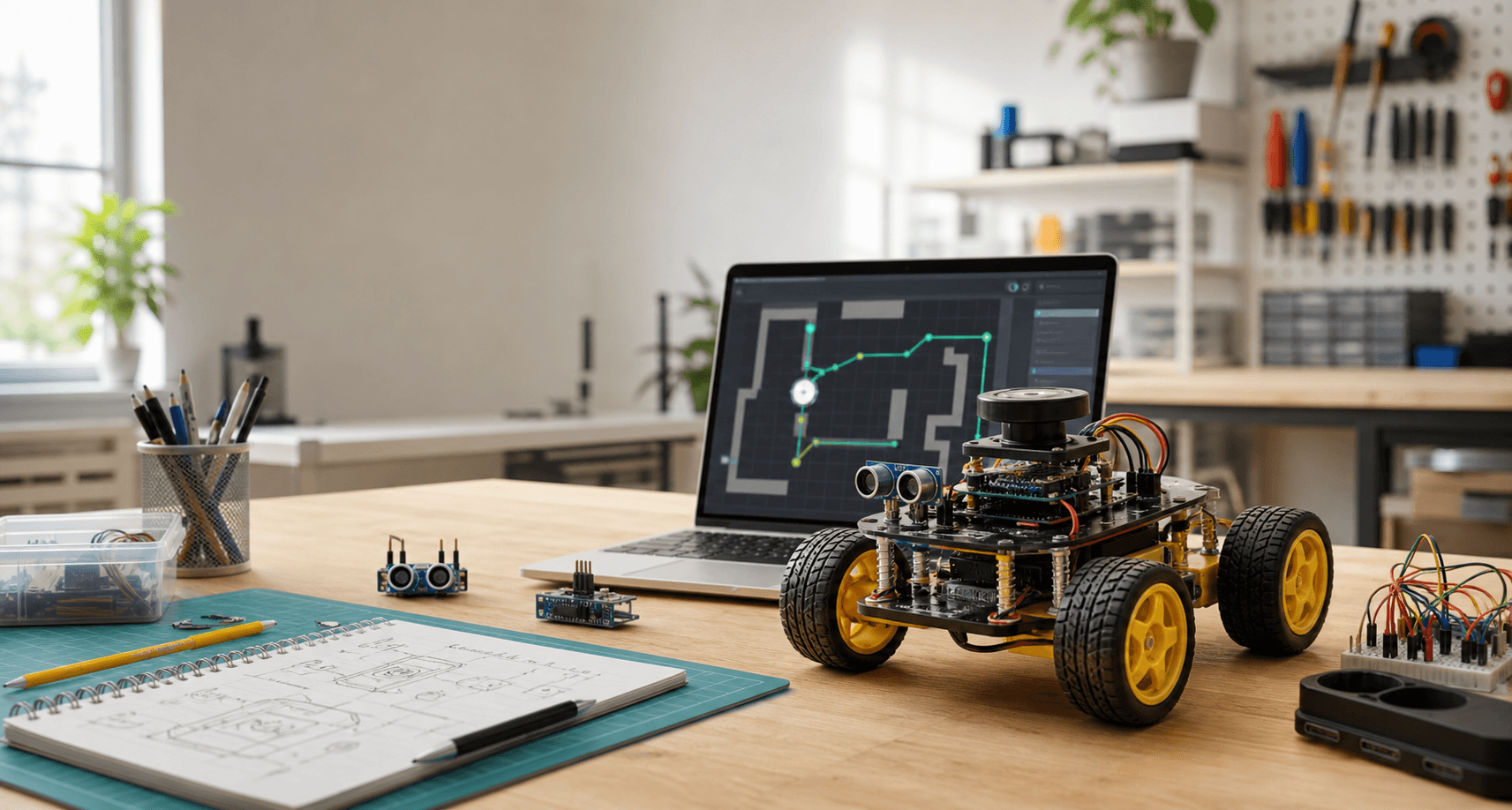
Build the math, code, hardware, and systems instincts behind real robots.

A practical curriculum guide that pairs core theory with trusted resources and follow-along projects from first simulations to ROS 2, controls, sensing, and autonomy.

4
learning stages
20
core topics
12
starter projects

A staged route from foundations to autonomous systems.

Each stage balances theory, implementation, and build practice so the material compounds instead of becoming a list of disconnected courses.

Stage 1. Foundations

Build the math, programming, and physics base needed to reason about robots as moving physical systems.

Topics

CalculusPythonMechanicsLinear algebraRobotics overview
  • Write clean Python programs and simple simulations.
  • Use vectors, matrices, and physics to describe motion.
  • Explain how sensing, planning, and control fit together.

Stage 2. Core Engineering

Add algorithms, electronics, probability, and dynamic systems so software can meet hardware cleanly.

Topics

Differential equationsData structuresE&MProbabilityCircuits
  • Analyze dynamic behavior and uncertainty.
  • Choose data structures for planning and perception tasks.
  • Prototype and debug basic electronic subsystems.

Stage 3. Robotics Core

Study the robot-specific core: kinematics, dynamics, controls, sensors, embedded systems, and ROS 2.

Topics

KinematicsControlsSensorsEmbedded systemsROS 2
  • Model robot motion with transforms and Jacobians.
  • Implement PID and state-space control loops.
  • Build ROS 2 nodes, topics, services, and transforms.

Stage 4. Specialization and Capstone

Turn the core into autonomy with perception, planning, learning, safety, and an integrated capstone.

Topics

Computer visionMotion planningMachine learningSafetyCapstone
  • Use vision and learning models for robot perception.
  • Plan paths with graph search, sampling, and trajectories.
  • Deliver an integrated robot system with documentation.

A curated shelf for each part of the stack.

These links favor free or widely used materials that can anchor an independent study plan.

MIT OCW 18.06 Linear Algebra

MathBeginner

A strong base for kinematics, estimation, controls, and almost every serious robotics topic.

Open

Modern Robotics

RoboticsIntermediate

Book, videos, and software for rigid-body motion, kinematics, dynamics, control, and planning.

Open

ROS 2 Documentation

ROS 2All levels

The reference point for nodes, topics, services, transforms, packages, and middleware concepts.

Open

Stanford CS 123

CourseBeginner

A hands-on introduction to building AI-enabled robots with modern software and hardware tools.

Open

Hugging Face Robotics Course

AIBeginner

Introductory robotics lessons connected to learning-based systems and open-source tooling.

Open

NVIDIA Physical AI Learning

SimulationIntermediate

Self-paced courses for Isaac Sim, Isaac Lab, Isaac ROS, digital twins, and sim-to-real workflows.

Open

Start with a scoped build, a parts plan, and a measurable finish line.

Only the proposals with complete phases, safety constraints, parts lists, and reference links are published here.

Programmable RC Car

BeginnerCore Engineering

Build a small remote-controlled car, then add telemetry and speed feedback as a robotics foundation.

Focus
Chassis, motor control, wireless commands, power safety
Final evidence
Proposal, wiring diagram, firmware, test log, and demo video.
View proposal

Autonomous 9-Inch Development Quadcopter

IntermediateRobotics Core

Build a roughly 9-inch (230-250 mm) motor-to-motor quadcopter with 5-inch propellers, PX4 flight control, telemetry, and a logged autonomous mission.

Focus
Airframe integration, flight control, power, telemetry, autonomy, ROS 2, safety
Final evidence
Proposal, wiring and power diagrams, configured airframe, flight logs, ROS 2 bridge, mission demo, and postmortem.
View proposal